Ultra Short Throw Projector: Pro AV Use Cases

Ultra Short Throw Projector: When the Throw Distance Is Almost Zero
In short. An ultra short throw is not a short throw taken to an extreme, it is a different alignment job. The throw ratio drops below 0.5: the projector sits almost against the surface, and the beam arrives at a very grazing angle. As a result, the surface has to be almost perfectly flat, uniformity and hotspot become the two major traps, and the placement is set to the millimetre. An ultra short throw unlocks installs that are otherwise impossible, a wall with no throw distance, a niche, a display case. But it forgives nothing. As soon as a reasonable throw distance exists, a standard lens gives a cleaner, brighter image.
An ultra short throw is not a short throw pushed one notch further. It is a different alignment job. Below a throw ratio of 0.5, the ultra short throw projector sits almost against the surface, and the slightest flatness or positioning fault shows.
It unlocks installs that are otherwise impossible. It also forgives nothing at all. This article tackles the angle that consumer guides ignore: the real pro use cases, and what the extreme angle costs in uniformity and alignment. For the general definition of throw ratio and standard short throw, see the short throw and throw ratio guide.
Ultra Short Throw: What a Throw Ratio Below 0.5 Changes
We are not redefining the throw ratio here. The full definition, the calculation, the lens choice, that is in how to calculate and choose a throw ratio. We go straight to the ultra short throw threshold.
The Threshold Below 0.5: the Projector Almost Glued to the Surface
A throw ratio below 0.5 defines ultra short throw. At 0.4, the projector sits at a fraction of the image width from the surface. It is placed almost against the wall, or just below it.
For context: standard short throw covers a range of 0.8 to 1.5, large-format outdoor projection runs from 1.5 to 2.5. Ultra short throw is another territory. Manufacturers such as Epson document their ultra short throw lenses and their throw ratio ranges on the product spec sheets.
Why the Extreme Angle Makes Ultra Short Throw Different
With almost no throw distance, the beam does not arrive head-on. It arrives grazing. The angle between the beam and the surface becomes very tight.
That is what changes everything. A grazing angle amplifies the slightest surface fault, exaggerates brightness gaps, and makes placement critical. A regular short throw stays more tolerant. The ultra short throw, by physical design, is not.
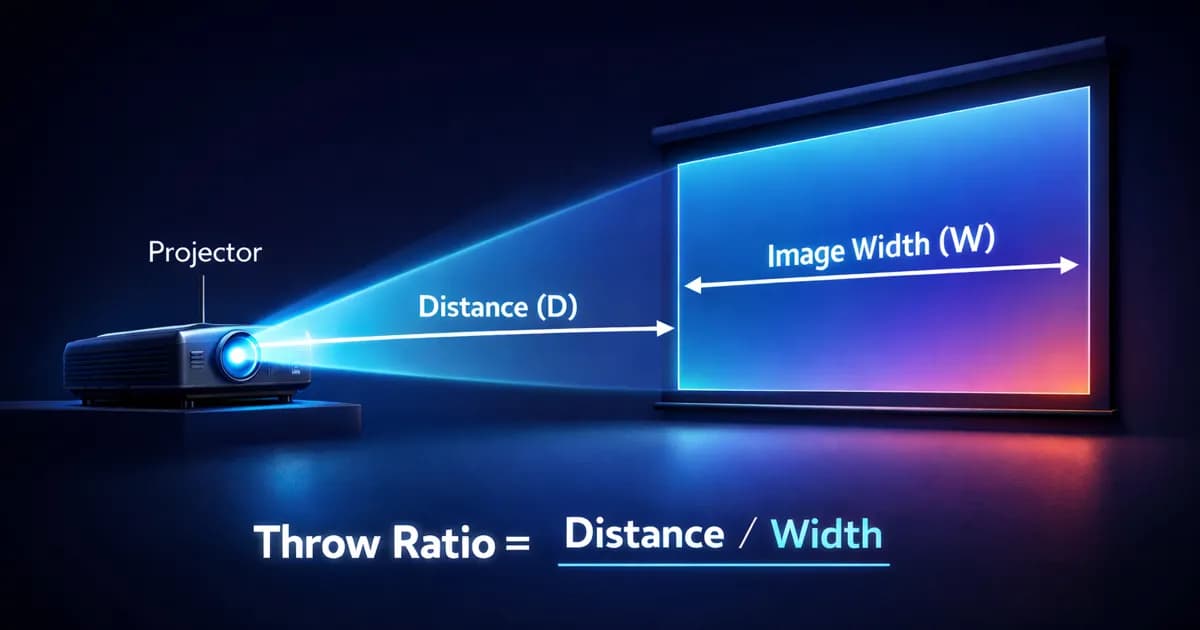
Throw Distance Equals Throw Ratio Times Image Width: What That Gives Below 0.5
The formula does not change: throw distance equals throw ratio multiplied by image width. With a throw ratio of 0.4 on an image 2 metres wide, the projector sits 80 centimetres from the surface.
The spec sheet gives a throw ratio range, not a fixed figure. You have to cross it with the target image size. The throw ratio and projection distance calculator avoids the placement error, and above all it avoids finding out on installation day that the range does not cover the size you want.
When the Ultra Short Throw Is the Right Answer
The ultra short throw is not a gadget. It is the tool for a precise constraint: the throw distance does not exist. Here are the cases where it is justified.
The Wall With No Throw Distance: Partition, Display Case, Niche
The textbook case. A partition to project on with no space in front of it. A closed display case. A recessed niche. No standard or even short throw lens fits, because the distance simply is not there.
The ultra short throw, placed against the surface or very close to it, covers the image when nothing else can. That is its reason to exist.
Floor Projection and the Projection Table
Projecting downwards, onto a table or onto the floor, without cluttering the space above. A standard projector would need a large ceiling height and a central rigging structure.
The ultra short throw sits at the edge of a table or zone, and projects downwards with a minimal throw distance. The useful space stays clear. It is a case where the extreme angle is exactly what you are looking for.
The Lived-In Set: Projecting Without the Audience Crossing the Beam
In a set where the audience moves around, or with furniture, a projector at a distance has its beam cut. Each person, each piece of furniture casts a shadow on the surface.
An ultra short throw placed very close to the surface attacks at an angle that leaves no walk-through zone in the beam. No one crosses it, because there is almost nothing to cross. The set stays liveable.
Signage and Retail: a Visual Where No Projector Fits at a Distance
In retail, in dynamic signage, you often want a visual on a precise surface, in a space where no projector would fit at a distance. A shop wall, a column, a counter.
The ultra short throw makes that visual possible where the space constraint is total. Not to be confused, by the way, with the consumer ultra short throw: that one sits in a dedicated ultra short throw projector cabinet, under a living-room TV. That is another use, another market.
The Constraints Consumer Guides Do Not Show
Here is what no home cinema guide says. The extreme angle has a price, and it is paid at alignment.
Surface Flatness: at a Grazing Angle, a 5 mm Bump Becomes a Shadow
At a grazing angle, the relief of the surface gives itself away. A bump of a few millimetres, invisible head-on, projects a long, clearly visible shadow under the ultra short throw beam.
That is the underlying trap. An ultra short throw on an uneven wall turns every fault into a shadow. The surface has to be almost perfectly flat, otherwise the alignment will never hold.
Uniformity and Hotspot: the Number One Trap, Amplified by the Extreme Angle
The hotspot is a zone brighter than the edges. The more grazing the beam arrives, the more light the centre receives compared to the edges, the more visible the hotspot becomes.
It is the recurring fault of the ultra short throw, and the extreme angle amplifies it. On a quote, it does not show. On a uniformity test pattern, it jumps out. You project a test pattern and you look at the edges before validating anything.
Focus Across the Whole Diagonal: the Far Corner vs the Near Corner
At a grazing angle, the corner of the image closest to the projector and the farthest corner are not at the same optical distance. The focus has to hold across the whole diagonal.
It is harder than with a projector head-on, where the whole image is at roughly equal distance. An ultra short throw demands checking sharpness corner by corner, not just at the centre.
Placement Sensitivity: a Few Millimetres, an Image Off-Kilter
At very low throw distance, the angle amplifies everything. A few millimetres of projector offset distort the image visibly. A surface not perfectly parallel to the projector creates a keystone.
The mechanical adjustment is done to the millimetre. It is physics: the less throw distance you have, the bigger every position error shows.
Calibrating an Ultra Short Throw: What Changes in Practice
Aligning an ultra short throw does not look like aligning a projector at a distance. The order of operations matters.
Mechanical Adjustment Before Software Adjustment
You set the rig before you touch the warp. Projector position, parallelism with the surface, height, everything is adjusted physically first, to the millimetre.
The reflex of correcting poor placement with software is wrong here. On an ultra short throw, an approximate placement creates a problem the warp does not cleanly recover. Mechanical first, always.
Keystone and Geometric Correction: What Can Be Recovered, What Cannot
Keystone corrects a trapezoidal distortion by calculation. It sacrifices pixels and sharpness. On an ultra short throw, the temptation to recover everything with keystone is strong, and it is a mistake.
Keystone gets you out of a jam, it does not calibrate. An image off-kilter because the projector is badly placed is corrected by replacing the projector. For mapping, you place it correctly and you warp in the media server. Keystone is not a placement crutch.
The Test Pattern Check Before Validating: Uniformity and Corner-to-Corner Sharpness
Before saying an ultra short throw is aligned, you project a test pattern. You check the uniformity, you look for a hotspot, you check the sharpness of every corner.
It is the last step, and it is not negotiable. A test pattern shows in thirty seconds what an animated content hides for hours. If the centre burns or a corner is blurry, the problem gets fixed now, not in the show.
When the Ultra Short Throw Is Not Worth It
The ultra short throw is a tool for an extreme constraint. Outside that constraint, it is the wrong choice. Four cases.
As soon as a reasonable throw distance exists. A well-chosen standard or short throw lens gives a cleaner, brighter image. If the distance is there, you use it. For the detail of the lens choice, see the complete projector lens choice guide.
On a surface you cannot guarantee flat. An ultra short throw on an uneven wall is creating a permanent alignment problem. If the flatness is not guaranteed, the grazing angle will turn every fault into a shadow.
On large format. The extreme angle spreads the lumens and amplifies the faults. The ultra short throw is not made for large surfaces. On a large format, you usually have the throw distance, and a longer throw ratio looks better.
When the budget is tight. For equal useful lumens, a pro ultra short throw costs more. If the throw distance is available, the money is better placed elsewhere: a reliable media server, hours of alignment. Choosing an expensive ultra short throw when a throw distance exists is hardware chosen for the margin, not for the need.
Direct Answers
What is the difference between short throw and ultra short throw? Short throw covers a throw ratio of roughly 0.8 to 1.5: the projector stays at a reduced but real distance from the wall. Ultra short throw drops below 0.5: the projector sits almost against the surface. It is not one degree more, it is another use case and another alignment.
What throw distance do you need for an ultra short throw projector? Throw distance equals throw ratio multiplied by image width. With a throw ratio of 0.4 on an image 2 metres wide, the projector sits 80 centimetres from the surface. The spec sheet gives a range, not a fixed figure: you have to cross it with the target image size. A throw ratio calculator avoids the error.
Do you need a special screen for an ultra short throw? For mapping, no: you project on the real surface. For a screen projection, yes, the question becomes serious: at a grazing angle, a standard screen returns light poorly. There are screens designed for ultra short throw that handle the extreme angle. On a wall, flatness matters more than the nature of the finish.
Why is uniformity a problem on ultra short throw? Because the projection angle is extreme. The more grazing the beam arrives, the more light the centre of the image receives compared to the edges, and the more visible a hotspot becomes. It is the recurring fault of the ultra short throw: to be checked on a test pattern before validating the hardware.
Can you do video mapping with an ultra short throw? Yes, when the layout demands it: a wall with no throw distance, a niche, a display case. The ultra short throw unlocks installs that are otherwise impossible. The trade-off: the surface has to be almost perfectly flat, and the alignment demands more mechanical care than a projector at a distance.
Is the ultra short throw suitable for large-format outdoor mapping? Rarely. On a large format, you usually have the throw distance you need, and a longer throw ratio gives a brighter, cleaner image. The extreme angle of the ultra short throw spreads the lumens and amplifies surface faults: it is not the tool for the big facade.
Why is the ultra short throw so sensitive to placement? Because at very low throw distance, the angle amplifies everything. A few millimetres of projector offset distort the image visibly, and a surface not perfectly parallel creates a keystone. The mechanical adjustment is done to the millimetre, before any software adjustment.
The ultra short throw solves a problem nothing else solves: the near-zero throw distance. Outside that case, it costs in uniformity and alignment what it saves in space. The right reflex is not to choose it to look modern, it is to measure the available throw distance, then decide. If you have a brief that imposes an ultra short throw and a doubt about the surface, a second opinion on a projection layout is settled before the install, not after.

Video mapping consultant and trainer
Fifteen years of monumental and museum-grade installations: Arc de Triomphe (7 editions), Museum of Art and Light Kansas (108 projectors), Atelier des Lumières. Design, multi-projector calibration, audit, Modulo Kinetic training.
Need technical expertise?
Let's discuss your video projection or mapping project. Reply within 48h business hours.
Discuss your projectDid you enjoy this article?
Receive my upcoming tips, field experience and best practices straight to your inbox.
By subscribing, you agree to receive our emails. You can unsubscribe at any time.
1 email per week maximum, unsubscribe in 1 click