Short Throw Projector: A Pro AV Buyer's Guide

Short Throw Projector: When to Pick One on a Pro Project
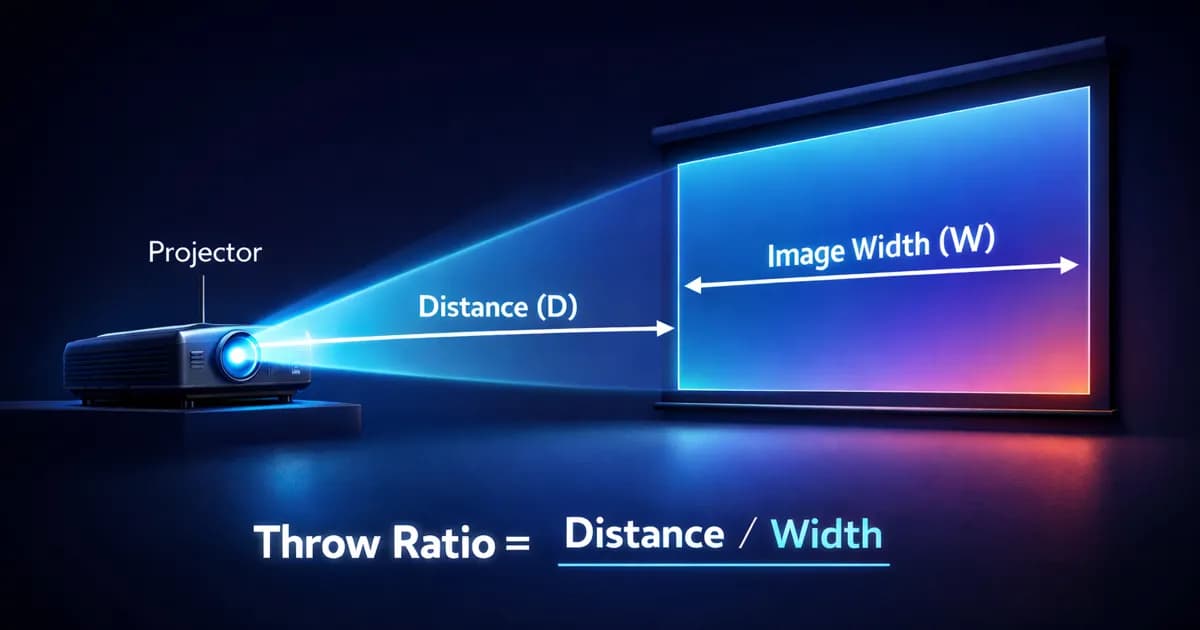
In short. A projector's short throw is measured by its throw ratio: projection distance divided by image width. Indoors you usually work between 0.8 and 1.5. Below 0.5 you are in ultra short throw territory. On a pro project, short throw is not a comfort choice, it is a response to a constraint: a wall you cannot move back from, an impossible rigging point, a blend to pull off indoors. It has a cost: the wide angle spreads the lumens and makes uniformity harder to hold. This guide explains when short throw saves an install, how to read a throw ratio on a quote, and the three cases where it is not worth it.
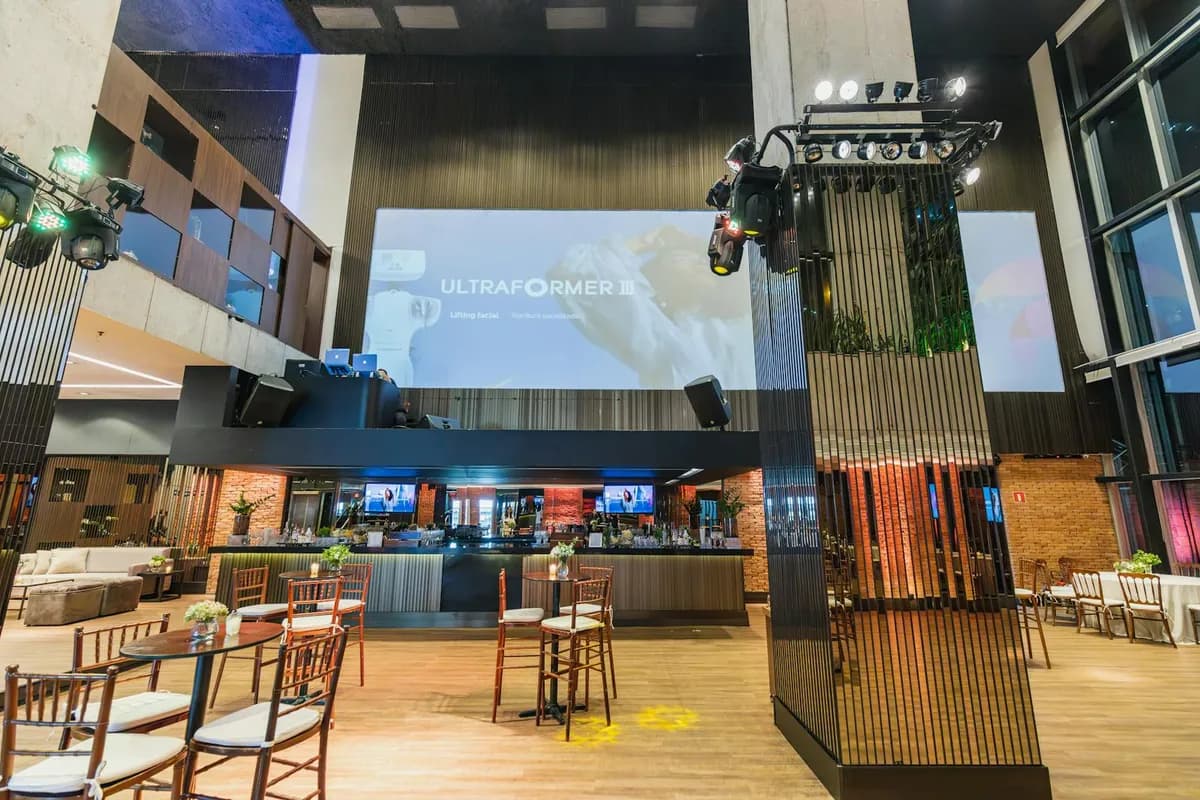
Out of eight indoor installs I get called in to fix, seven have the same problem upstream. The projector was picked before anyone measured the available distance. Throw ratio eyeballed, projector ordered off the spec sheet, and on rigging day you find out it needs to hang three meters further back. Three meters that do not exist, because there is a wall, a glass roof, or the bar.
A projector's short throw lens exists for exactly these cases. Not to look neat in a living room. To unlock a wall you cannot move back from.
Short throw, throw ratio: what you are actually measuring
The throw ratio, the only number that decides
The throw ratio is a ratio. Projection distance divided by image width. A throw ratio of 1.0 on a 4-meter-wide image puts the projector at 4 meters. A throw ratio of 0.8 brings it in to 3.2 meters.
It is the only number that decides whether a projector fits your space. Not the lumens, not the resolution, not the brand. The distance. For the full calculation and how to pick one, see how to calculate and choose a throw ratio.
Short throw is one object, several names
You will read short throw projector, short throw lens, short focal length. It is the same object. A projector whose lens throws a large image from a short distance. The wording changes nothing about the physics. A low throw ratio, a wide projection angle.
The throw ratio ranges
Three reference points to keep in mind:
- Indoor, short projection: throw ratio 0.8 to 1.5. This is short throw territory.
- Outdoor, large format: throw ratio 1.5 to 2.5. You have the distance, you use it.
- Ultra short throw: throw ratio below 0.5. The projector sits almost against the surface.
A projector does not have a single throw ratio. Its spec sheet gives a range, which depends on the lens fitted. That range is what you cross-check against the target image size, not the other way round.
When short throw saves a mapping job
The wall you cannot back away from
The most common case. A wall in a corridor, a closed scenography, a shop window. The surface to cover is 4 meters wide, and the wall opposite is 3 meters away. With a standard lens at a 2.0 throw ratio, you would need to pull back to 8 meters. They do not exist.
A short throw lens at 0.8 puts the projector at 3.2 meters. The image fits. It is that simple, and that decisive.
The rigging constraint
Sometimes the distance is there, but the fixing point is not. No structure in the right spot, no permission to drill, a false ceiling that holds nothing. Short throw brings the projector closer to the surface, so closer to the rigging points available. On a heritage building where every drill hole is negotiated, that changes the project.
The indoor blend
Overlapping two projectors to cover a large surface is edge blending. Indoors, doing it with standard lenses often forces you to hang the projectors far back, against the rear wall. Short throw lets you keep them closer to the projected surface. The trade-off: the blend zone needs more attention, because both beams hit at a sharp angle.
Shadows cast by the crowd
Projecting over a crowd without going through it. If the projector sits low and far, every head casts a shadow on the wall. A short throw lens rigged closer and higher hits the surface at an angle that clears the audience. The cast shadow disappears.
Reading a quote: what a short throw projector changes
Useful lumens: think in lux, not spec-sheet lumens
A short throw projector does not have fewer lumens than another. But the perceived result can drop. The wide angle spreads the same light flux over a surface that is often larger at a given distance.
What matters is not the spec-sheet number, it is the lux on the surface. Indoors, a controlled lighting environment needs 70 to 100 lux on the wall. Outdoors at night, you climb to 200-300 lux. A short throw projector rated at 8000 lumens can read like 4000 if the angle spreads too much. That is physics, not a defect.
Uniformity and hotspot: trap number one
A hotspot is a central zone brighter than the edges. The wider the projection angle, the harder uniformity gets to hold. It is the recurring flaw of wide-angle short throw lenses.
On a quote, you cannot see it. On a uniformity test pattern, it is obvious. Before signing off on short throw gear, you project a test pattern and look at the edges. If the center burns and the corners fall off, the problem will not be fixed in post.
Lens shift and keystone: what adjusts, what does not come back
Lens shift moves the image without moving the projector. It is mechanical, it is clean. Keystone corrects a trapezoidal distortion by calculation, sacrificing pixels and sharpness.
On a short throw lens, the sharp angle tempts you to use keystone to fix everything. Bad reflex. Keystone gets you out of a bind, it does not calibrate. For mapping, you place the projector correctly and warp in the media server. You do not rely on keystone.
Short throw or ultra short throw: do not mix them up
Ultra short throw drops below a 0.5 throw ratio. The projector sits almost against the surface, or just below it: projection table, floor, very small distance. It is a different tool, for a different use case. The angle is extreme, uniformity is even trickier, and the surface choice becomes critical.
Short throw covers a reduced distance. Ultra short throw covers a near-zero distance. A dedicated article will cover ultra short throw in detail. For lens choice in the broader sense, see the complete guide to choosing a projector lens.
When short throw is not worth it
Short throw is not an upgrade. It is a response to a constraint. Three cases where it is the wrong call.
On a large outdoor format. There, the distance almost always exists. A longer throw ratio, between 1.5 and 2.5, gives a brighter, cleaner image. Forcing a short throw lens onto a facade means losing useful lux and amplifying every flaw in the surface.
When the distance is available. If you have the room, a well-chosen standard lens beats a forced short throw. Better uniformity, an easier hotspot to control, often cheaper for the same lumens.
When the budget is tight. A pro short throw lens costs more for the same lumens than a standard lens. If the distance is there, the money is better spent elsewhere: a reliable media server, hours of on-site calibration. Oversizing the lens to compensate for a poorly scoped brief means paying twice.
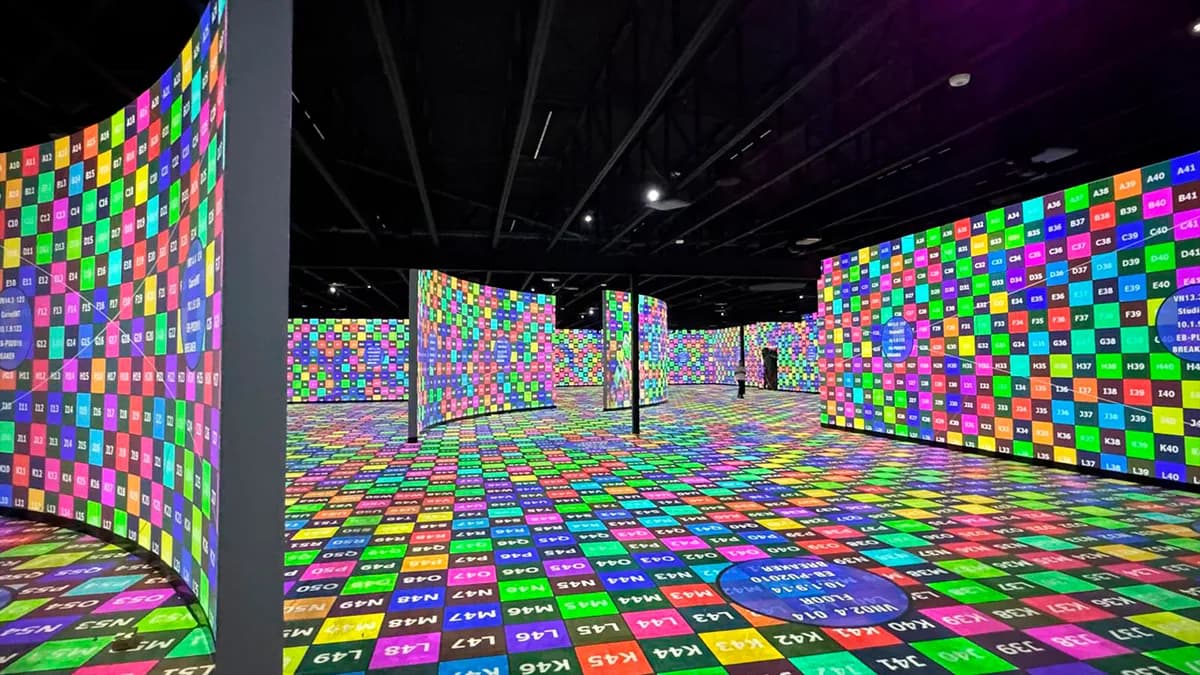
A project on a site like the Bassins de Lumières in the Culturespaces network calls for short throw lenses because the rooms are enclosed and the volumes are tight. There, short throw is the right answer. On an open facade, it is rarely justified.
Direct answers
What is the difference between short throw and ultra short throw? Short throw covers a throw ratio of roughly 0.8 to 1.5: the projector stays a reasonable distance from the wall. Ultra short throw drops below 0.5: the projector sits almost against the surface. Two tools, two use cases. Short throw for a reduced distance, ultra short throw for a near-zero distance.
How do you calculate the distance for a short throw projector? Distance equals throw ratio multiplied by image width. A throw ratio of 0.8 on a 4-meter-wide image puts the projector at 3.2 meters. The spec sheet gives a throw ratio range, not a fixed number: you cross-check it against the target image size. The throw ratio and projection distance calculator keeps you out of trouble.
Does a short throw lens lose lumens? Not the projector itself, but the perceived result can drop. A wide angle spreads the same flux over a surface that is often closer and larger at a given distance. You have to think in lux on the surface, not in spec-sheet lumens.
Is short throw suited to outdoor video mapping? Rarely. On a large outdoor format you usually have the distance you need, and a longer throw ratio, between 1.5 and 2.5, gives a cleaner, brighter image. Short throw is only justified outdoors when the layout genuinely forces the projector close.
What is a hotspot and why does short throw create one? A hotspot is a central zone brighter than the edges. The wider the projection angle, the harder uniformity gets to hold. It is the recurring flaw of wide-angle short throw lenses: check it on a test pattern before signing off on the gear.
Can you blend two short throw projectors? Yes, and that is often the point indoors: overlapping two images without hanging the projectors far back. The trade-off: the blend zone needs more attention on uniformity, because both beams hit at a sharp angle.
Do you need a special screen for a short throw lens? For mapping, no: you project onto the real surface. For screen projection, some surfaces handle grazing angles better. The question mostly comes up with ultra short throw, where the angle is extreme.
Short throw is a constraint tool. It unlocks the walls you cannot back away from, and it costs in uniformity and lux what it gains in space. The right reflex is not to pick it by default, it is to measure the distance first, then decide. If you have a projection quote to sign off and a doubt about the lens, a second opinion on a projection quote costs less than a projector that does not fit on rigging day.

Video mapping consultant and trainer
Fifteen years of monumental and museum-grade installations: Arc de Triomphe (7 editions), Museum of Art and Light Kansas (108 projectors), Atelier des Lumières. Design, multi-projector calibration, audit, Modulo Kinetic training.
Need technical expertise?
Let's discuss your video projection or mapping project. Reply within 48h business hours.
Discuss your projectDid you enjoy this article?
Receive my upcoming tips, field experience and best practices straight to your inbox.
By subscribing, you agree to receive our emails. You can unsubscribe at any time.
1 email per week maximum, unsubscribe in 1 click