The Children's Workshop: When Drawings Come to Life Through Projection

The Children's Workshop: When Drawings Come to Life Through Projection
Introduction
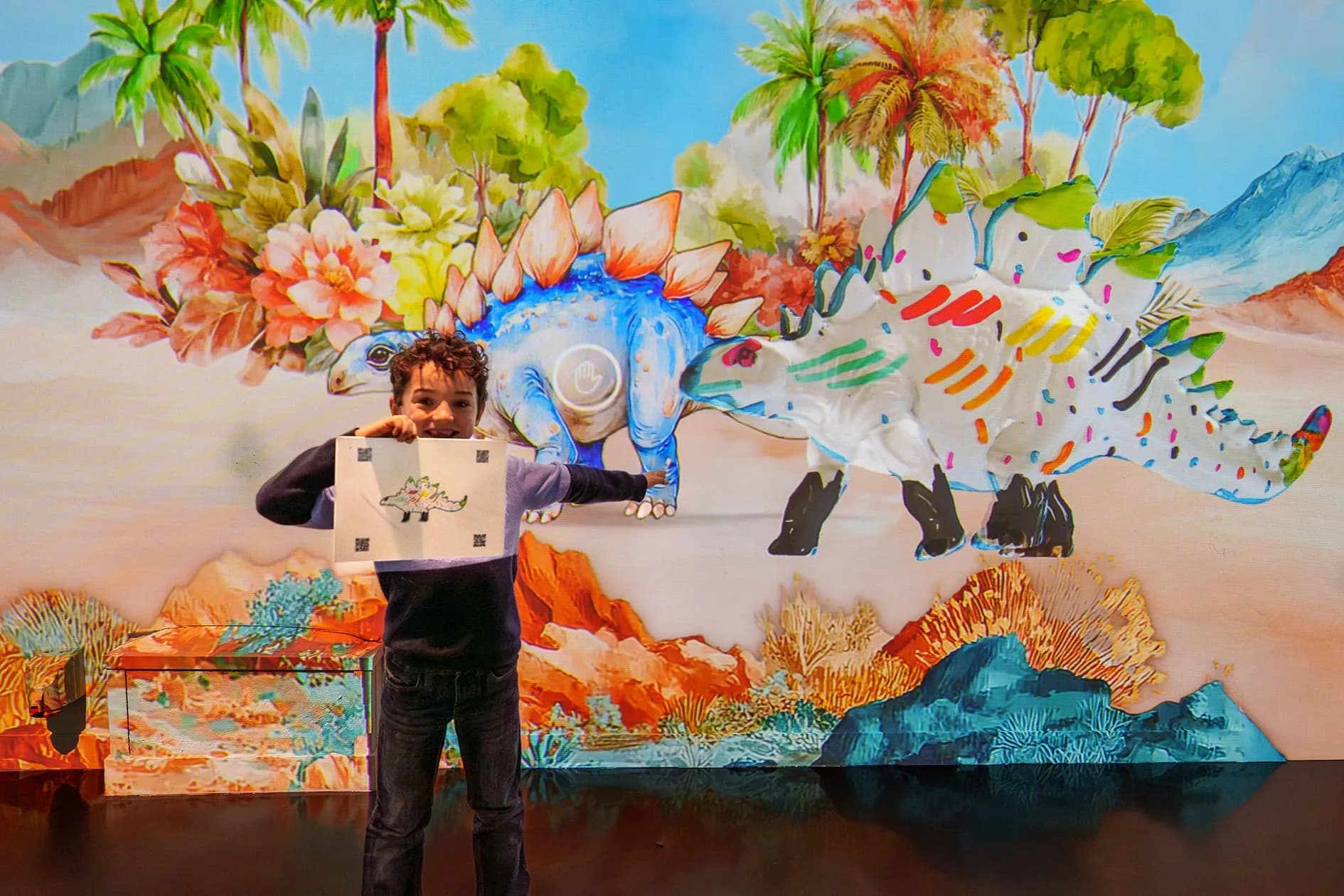
The Children's Workshop is one of those projects where technology and emotion meet in a rare way. The concept: a child colors a dinosaur on paper, scans it, and watches their drawing animate at large scale on an immersive projection wall. All of this at l'Atelier des Lumieres, in Paris.
This project was designed and delivered with Culturespaces STUDIO, Spectre Lab and Modulo Pi, and was recently featured in MONDO-DR magazine (pages 58-59), an international reference in professional audiovisual and entertainment.
Here is a field report on this installation: how it works, what it requires technically, and why this type of interactive setup has a real future in cultural venues.
The concept: draw, scan, project
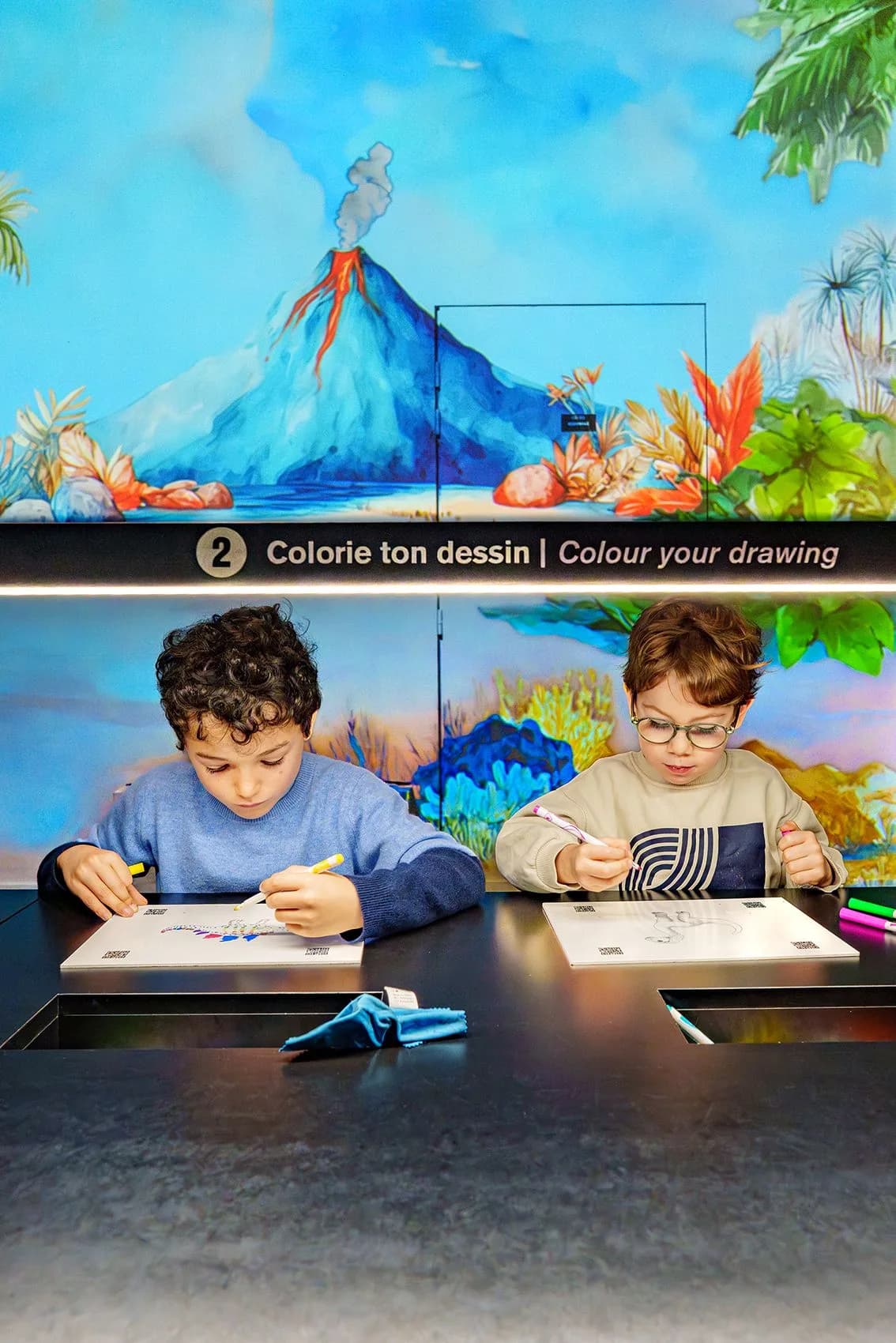
The visitor journey is deliberately simple. The child enters a dedicated area within the immersive exhibition, with coloring tables set up facing the projection wall.
The process, step by step:
- The child receives an illustrated template related to the current exhibition theme (here, dinosaurs: stegosaurus, triceratops, etc.)
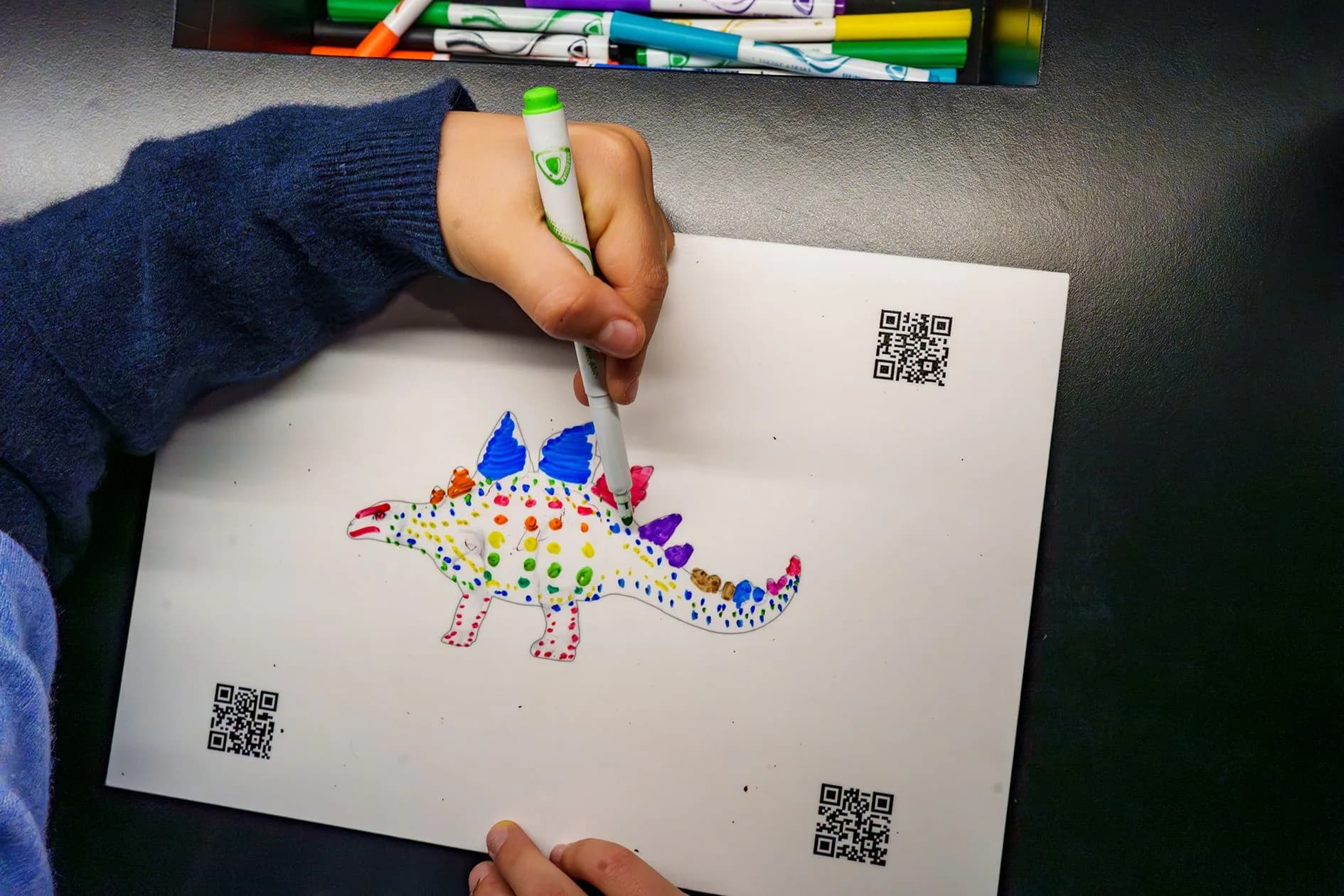
- They color their drawing however they like with the markers provided
- Once finished, they go to a dedicated scanning station
- The drawing is captured via a scanner equipped with QR codes to identify the template
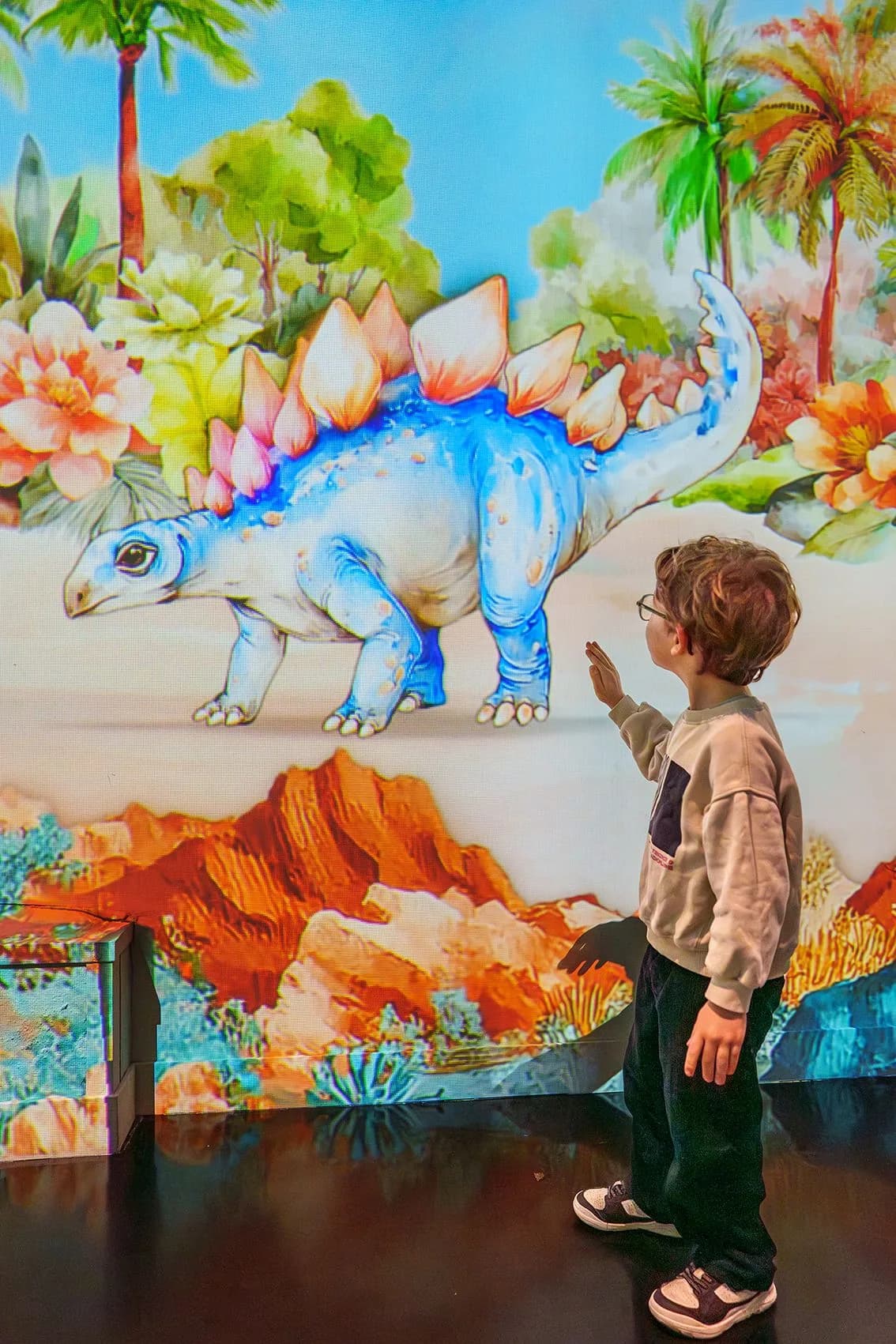
- Within seconds, their colored dinosaur appears animated on the projection wall, at large scale
The effect is immediate: the child recognizes their colors, their strokes, their drawing, projected large in an animated landscape. They point, run to show their parents. It's a moment of pride, play, and discovery.
And that's exactly what makes this setup so effective: the feedback loop is short (a few seconds between scanning and appearing), the result is spectacular, and the child leaves with a physical keepsake (their coloring page).
The technical chain: from scanner to wall
Behind the apparent simplicity of the visitor journey, the technical chain is well established. Here's how it all fits together.
The scanner
The scanning stations are robust physical units, designed to withstand intensive use by children. Each printed template includes QR codes along the edges that allow the system to identify the model (stegosaurus, triceratops, etc.) and isolate the colored area.
The scan captures the image in high resolution, extracts the colors applied by the child, and sends everything to the server via the local network.
Modulo Kinetic: real-time compositing
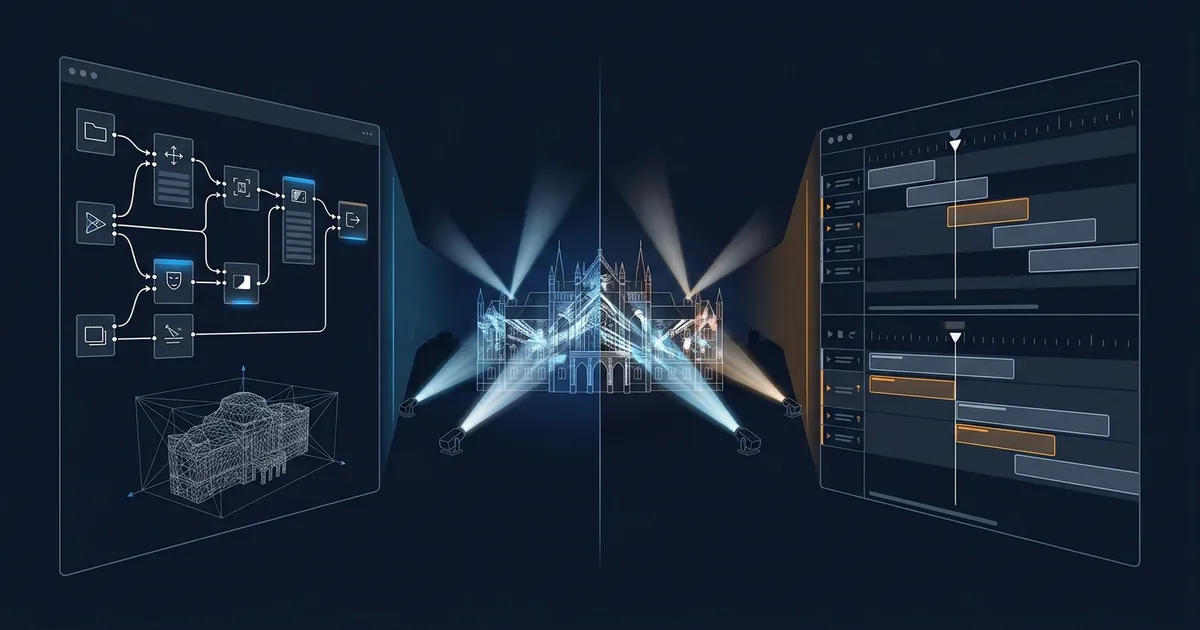
Modulo Kinetic orchestrates everything. The media server receives the scanned image, applies it as a texture on an animated 3D model of the corresponding dinosaur, and integrates it into the visual composition projected on the wall.
Why Kinetic over another tool? Several reasons:
- Reliability: the installation runs 7 days a week, all year round. You need a system that doesn't crash
- Remote maintenance: the technical team can intervene without traveling on-site
- Multi-source management: Kinetic simultaneously handles the pre-rendered exhibition content and the real-time scanned drawings
- Controlled latency: between scanning and appearing on the wall, less than 5 seconds pass
The projection
The projection wall is covered by multiple calibrated projectors with edge blending (blending the edges between adjacent projectors). Calibration is managed by Modulo Kinetic, with a dedicated profile for the interactive space.
Why it works for museums
This type of interactive installation addresses several concrete challenges that cultural venues face.
Active engagement for children. In a classic immersive exhibition, children are spectators. With the Children's Workshop, they become participants. They create something, see the result, and take ownership of the experience. The engagement is incomparable.
A tangible souvenir. The child leaves with their coloring page. It's a physical, personal object that they show to family and friends. For a museum, that's organic word-of-mouth.
Thematic renewal. When the exhibition changes (from Klimt to dinosaurs, from Impressionists to ancient Egypt), the coloring templates change too. The technical system stays the same, only the graphic assets are updated. This allows the experience to be renewed without reinvesting in hardware.
Processing capacity. The system handles peaks of 30 to 50 children simultaneously. During school holidays or weekends, that's essential. The installation doesn't create a blocking queue: children color at their own pace and scan when they're ready.
Operational autonomy. Museum staff don't need advanced technical training. The system runs autonomously with minimal supervision. That's a decisive factor for venues operating with lean teams.
Field challenges
Installing this type of setup in a museum is not the same as building a lab prototype. Here are the challenges encountered in the field.
Equipment robustness. Children are not gentle with equipment. Scanning stations must handle thousands of uses per week. Markers need to be easy to replace. Tables must be the right height, stable, and easy to clean.
Lighting. It's a constant compromise. Coloring stations need enough light for children to see what they're drawing. But immersive projection requires a dark environment. The solution: localized, directional lighting on the tables, with partitions or light shields to prevent spill onto the projection wall.
Flow management. You need to avoid bottlenecks at the scanners. Table layout, number of scanning stations, circulation paths: all of this is planned upstream and tested with real visitors during the commissioning phase.
Calibration over time. When an installation runs 7 days a week for months, calibration can drift. Projector lamps age, colorimetry shifts. A good automatic (or semi-automatic) calibration system is essential to maintain visual quality without daily intervention.
Lessons for other interactive projects
This "draw, scan, project" model can be adapted well beyond digital art museums.
In corporate events: participants draw on a brand-related theme and see their creation integrated into a collective projected mural. Engagement and brand recall are very strong.
In education: in libraries, science centers, traveling exhibitions. Children learn by creating, and the visual result reinforces retention.
In brand activations: flagship stores, trade shows, product launches. The "I create, I see, I share" mechanism generates organic social content.
Key factors for success:
- A reliable pipeline: from scan to wall, every link must work without supervision
- Low latency: if the child waits more than 10 seconds, the magic fades
- A clear visitor flow: no need for explanations, the path must be intuitive
- Testing with real children: I insist, this is essential. Children never do what you expect. They scan upside down, color outside the lines, get marker everywhere. Each test session reveals edge cases that no adult would have imagined
Conclusion
Seeing this project recognized in MONDO-DR is a source of pride. Not just for the visibility, but because it confirms that interactive projection has its place in permanent cultural spaces.
This type of installation is no longer a gimmick. It's a powerful mediation tool that transforms the relationship between the visitor and the artwork. And with the right tools (Modulo Kinetic, solid network infrastructure, thoughtful visitor flow design), it's reliable, maintainable, and scalable.
If you're considering an interactive projection project for your venue, feel free to get in touch. I can support you from technical design to commissioning.
Also check out my other interactive projects in the portfolio.

Video mapping consultant and trainer
Fifteen years of monumental and museum-grade installations: Arc de Triomphe (7 editions), Museum of Art and Light Kansas (108 projectors), Atelier des Lumières. Design, multi-projector calibration, audit, Modulo Kinetic training.
Need technical expertise?
Let's discuss your video projection or mapping project. Reply within 48h business hours.
Discuss your projectDid you enjoy this article?
Receive my upcoming tips, field experience and best practices straight to your inbox.
By subscribing, you agree to receive our emails. You can unsubscribe at any time.
1 email per week maximum, unsubscribe in 1 click