Event Mapping vs Permanent Installation

Event Mapping vs Permanent Installation: Which One to Choose?
In short. Event mapping (one-off show lasting a few hours to a few weeks) and permanent installation (immersive museum, theme park, cultural venue open 300 days a year) follow radically different economic logics. Event-based favors equipment rental, fast setup, ready-made pre-produced content, and a budget concentrated on the show; returns are measured per event. Permanent favors equipment purchase or leasing, durable integration (hidden cabling, redundancy, network supervision), evolving content, and a budget split between initial CAPEX and operating OPEX over 3 to 5 years; returns are measured per visitor. Equipment also differs: lamp projectors acceptable for short events, laser projectors near-mandatory in permanent for lifespan and stability. Maintenance, local crew training and 5-year TCO become major line items in permanent, negligible in event-based.
Introduction
When a client contacts me about a video mapping project, one of the first questions I ask is: "Is this for a one-time event or a long-term installation?"
The answer changes everything. Budget, equipment, workflow, maintenance, content, return on investment: nothing is sized the same way depending on whether you are projecting for a single evening or 365 days a year.
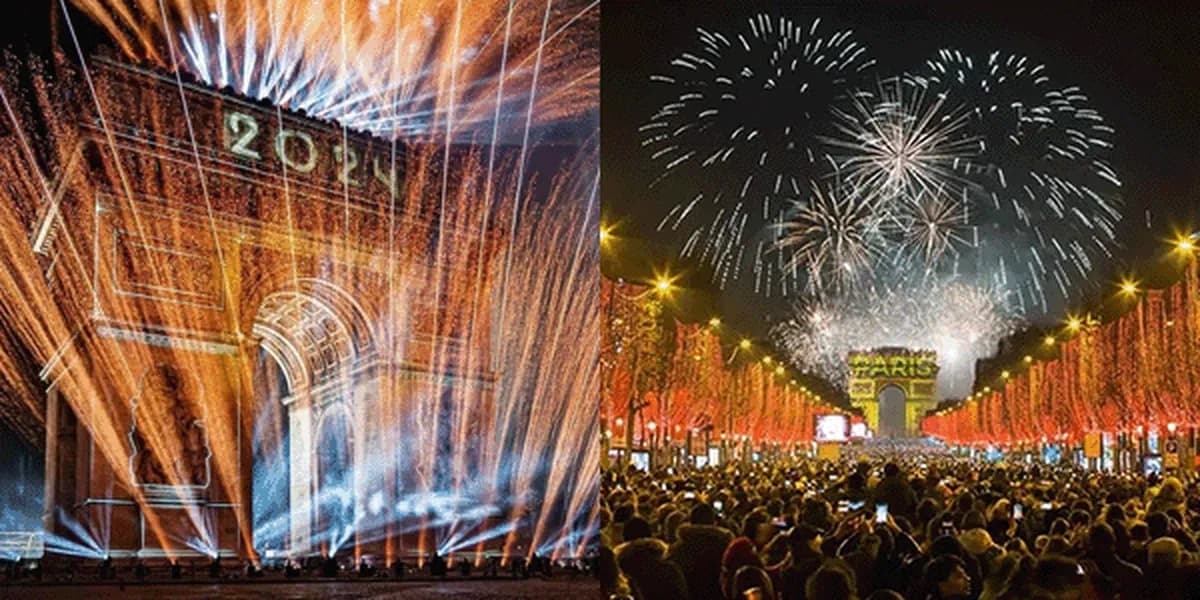
In 15 years of projects, I have worked on both formats. From ephemeral shows like the Arc de Triomphe mapping to permanent multi-site installations at Culturespaces, and the Museum of Art & Light in Kansas with its 108 projectors running every day.
This article compares both approaches criterion by criterion, with real figures, to help you choose the right format for your situation.
What is event mapping?
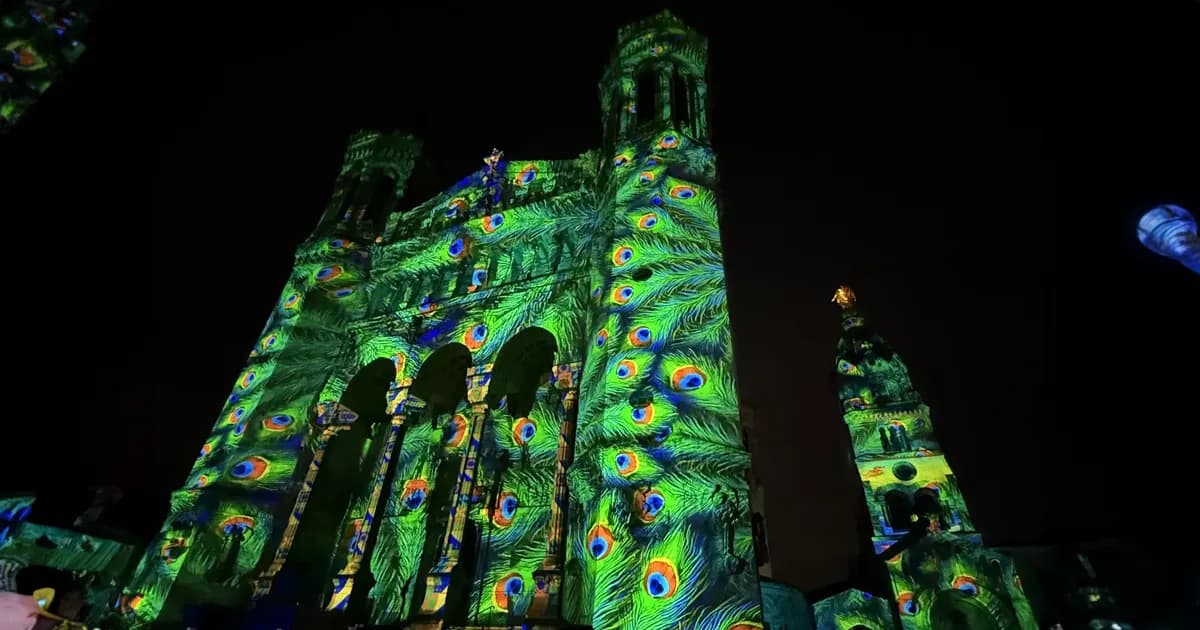
Event mapping is a temporary projection, set up and taken down around a specific event: inauguration, festival, sound and light show, product launch, corporate gala.
Characteristics:
- Operating duration: a few hours to a few weeks
- Rented equipment (projectors, media servers, cabling)
- Content created for a specific moment
- Technical crew present throughout the run
The equipment is sized for the event duration. You do not worry about lamp maintenance or electricity costs over 5 years. The goal is to create a powerful, visible, memorable moment.
Typical examples:
- Mapping show on a monument for a national celebration
- Facade projection for a brand launch
- Stage mapping for a concert or gala
- Christmas animation on a municipal building
What is a permanent installation?
A permanent installation is a projection system designed to operate daily, over several years. The equipment is purchased (or leased), integrated into the venue's architecture, and sized for continuous operation. Depending on usage intensity, equipment is typically replaced every 3 to 4 years.
Characteristics:
- Operating duration: 3 to 10+ years
- Equipment purchased (or leased) and integrated
- Clean installation (cable routing, ventilation, maintenance access)
- Content updated regularly (show rotation)
- Scheduled preventive maintenance
- Autonomous operation (no permanent operator)
The initial investment is higher, but the cost per day of operation decreases rapidly. It follows the logic of industrial equipment.
Typical examples:
- Immersive art center (Culturespaces, MoAL, teamLab, Meow Wolf)
- Museum with permanent projection rooms
- Corporate lobby or showroom
- Tourist attraction (daily sound and light show)
- Place of worship with architectural highlighting
Detailed comparison: 11 criteria
| Criterion | Event | Permanent installation |
|---|---|---|
| Duration | 1 day to 4 weeks | 3 to 10+ years |
| Budget | Variable depending on scope | Significant investment (leasing possible) |
| Equipment | Rental | Purchase or lease |
| Projectors | Lamp or laser, high power | Laser mandatory (lifespan) |
| Content | Unique, custom-made | Show rotation, updates |
| Maintenance | None (the rental company handles it) | Scheduled preventive maintenance |
| Crew on site | Yes, throughout the run | No, remote monitoring |
| Power consumption | Not significant | Major budget item |
| Ventilation / HVAC | Temporary | Integrated into the building |
| Redundancy | Optional | Essential |
| ROI | Brand image / communication impact | Ticketing / visitor traffic |
Key criteria in detail
Initial budget vs operating cost
This is the criterion that most often surprises decision-makers.
For events, the budget is one-time and predictable: equipment rental, installation, content, operation. Everything is included in a single quote.
For permanent installations, the initial investment is significantly higher (equipment, integration, content), but the equipment is typically leased and the cost is spread over several years. The equipment renewal cycle is 3 to 4 years depending on usage intensity.
Projector choice
For events, high-power lamp projectors (20,000 to 40,000 lumens) are commonly used. Lamps have a lifespan of 1,500 to 3,000 hours, but that is not an issue for a few days of use.
For permanent installations, laser is virtually mandatory. A laser projector has a lifespan of 20,000 to 30,000 hours. At 10 hours per day, that is 5 to 8 years without replacing the light source. A lamp projector under the same conditions would require a lamp change every 6 to 12 months, and lamp replacement costs add up quickly.
The laser premium (20-40% more than an equivalent lamp model) is recouped within 12 to 18 months of continuous operation.
Content: one-off vs evolving
For events, content is created for a specific moment. It tells a story tied to the occasion (inauguration, anniversary, launch). It is not meant to be replayed.
For permanent installations, content is a strategic asset. It must be refreshed to retain visitors. Immersive art centers change shows every 6 to 12 months. Each new show represents a significant investment in content production.
This is a recurring budget item that must be planned from the start. An immersive venue with a single show running for 3 years will see its attendance plummet.
Redundancy and reliability
For events, a projector failure is inconvenient but manageable. You have a crew on site, spare stock at the rental company, and the event lasts just a few hours.
For a permanent installation, a projector failing on a Saturday at 2pm when 500 visitors are waiting means direct revenue loss. Redundancy is not a luxury, it is a necessity:
- Projectors: Plan for 10-15% overlap so that losing one projector is invisible
- Media servers: Backup server ready to take over in seconds
- Network: Dual network paths, managed switches
- Power: UPS on critical equipment
Maintenance
For events: zero maintenance. That is the rental company's responsibility.
For permanent installations, maintenance is a dedicated line item:
- Filter cleaning: Every 2 to 4 weeks depending on the environment
- Alignment check: Monthly (structures move with temperature changes)
- Software updates: Quarterly
- Component replacement: As needed (fans, power supplies)
- Full recalibration: At least annually
Maintenance is a dedicated budget item that must be anticipated from the start of the project.
Expense items to anticipate
Budgets vary enormously from one project to another depending on size, complexity, and venue requirements. Rather than precise amounts, here are the items not to forget in your costing.
For events
- Projector and lens rental
- Media server rental + cabling
- Transport and handling
- Labor for installation and teardown
- Calibration and rehearsals
- Content creation
- Operation (technicians during the show)
For permanent installations
- Projectors (purchase or lease, replacement cycle every 3-4 years)
- Media servers and network infrastructure
- Fiber optic cabling
- Mounting structures, ventilation, technical room
- Installation, calibration, commissioning
- Initial content and regular renewal (1 to 2 shows/year)
- Engineering studies and coordination
- Preventive maintenance and spare parts
- Power consumption
- Technical support
Every project is unique. The best approach is to discuss your specific context for a realistic budget framework.
When to choose event mapping?
Event mapping is the right choice when:
- The occasion is unique: Inauguration, anniversary, one-time launch
- The budget is limited: The event format remains more financially accessible
- You are testing the format: Before investing in permanent, an event lets you validate public interest
- The venue is not suited: No technical room, no possibility for long-term integration
- The goal is communication: Buzz, media coverage, brand image impact
Hidden advantage of events: Scarcity creates value. A show that can only be seen on 3 evenings attracts more attention than an installation you can visit anytime.
When to choose a permanent installation?
A permanent installation is the right choice when:
- The venue welcomes visitors daily: Museum, attraction, shopping center, showroom
- The business model justifies it: Ticketing, increased foot traffic, real estate value
- The operating period exceeds 2 years: Below that, the equipment purchase cost is not amortized
- You can refresh the content regularly: A single show running for 5 years wears out the audience
- The infrastructure allows it: Technical room, sufficient power supply, ventilation
Hidden advantage of permanent: The installation becomes a marketing asset. It drives traffic, generates word-of-mouth, and differentiates the venue from competitors.
Case studies
Arc de Triomphe, event, monumental
The Arc de Triomphe mapping is a typical example of high-power event mapping:
- Surface: Several hundred square meters across the monument's facades
- Projectors: 15+ high-power projectors
- Duration: A few performances
- Crew: Dozens of technicians on site
- Impact: National media coverage, over one million spectators
This type of project would make no sense as a permanent installation. The cost would be disproportionate, the monument's constraints would make daily operation impossible, and the public's interest came precisely from the exceptional nature of the event.
Culturespaces, permanent, multi-site
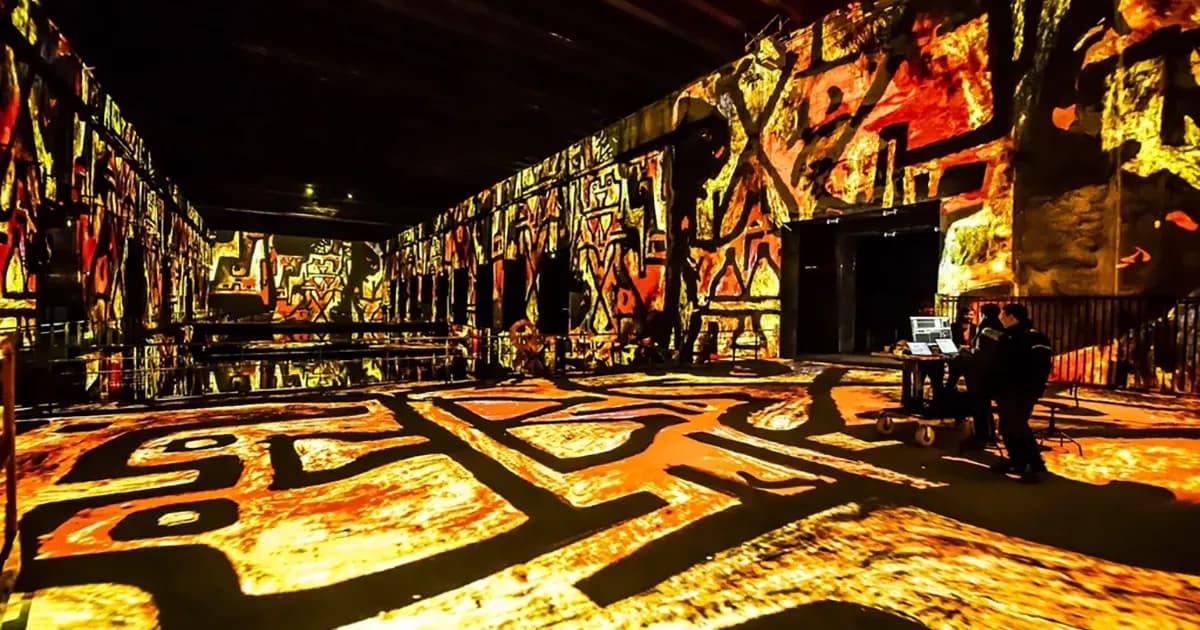
The Culturespaces digital art centers (Atelier des Lumieres in Paris, Bassins de Lumieres in Bordeaux, etc.) are the textbook case for permanent installations:
- Surface: 2,000 to 12,000 m2 of projection depending on the site
- Projectors: 60 to 150 laser projectors per site
- Operation: 300+ days/year, 10h/day
- Content: 2 to 3 shows per year, rotation every 6-8 months
- Attendance: 1 to 2 million visitors/year per site
The initial investment runs into millions of euros. But with high visitor volume (over one million visitors per year per site) and competitive ticket pricing, the return on investment is achieved within 2 to 3 years.
The key to success: regular content renewal. Each new show (Van Gogh, Klimt, Dali) relaunches attendance and generates a new wave of publicity.
Museum of Art & Light (MoAL), Kansas, permanent, ambitious
The MoAL pushes the concept even further with 108 projectors in a 3,400 m2 immersive space in Manhattan, Kansas. It is a permanent installation designed for intensive daily operation.
The distinguishing factor: reliability must be absolute. A venue closed for a day due to a technical failure means immediate revenue loss and reputational damage that is hard to recover from. This is why redundancy and preventive maintenance are critically important.
The hybrid format: recurring events
There is a third format, between the two: recurring events. This is a mapping show programmed regularly (every weekend, every summer, every holiday season) but not continuously.
Examples:
- Summer sound and light show on a castle (May to September, every evening)
- Christmas animation on a town hall facade (December)
- Weekly show at a theme park
This format raises an interesting question: repeated rental or purchase? The answer depends on the number of operating days per year.
Rule of thumb:
- Less than 30 days/year: Rental
- 30 to 60 days/year: Gray area, run the numbers
- More than 60 days/year: Purchase is probably more cost-effective
For the summer sound and light show (150 evenings/year), purchasing is clearly more advantageous. But beware: purchasing also means storage, off-season maintenance, and technical responsibility. You need a competent in-house team or a maintenance contract with a provider.
How to choose: the decision checklist
Answer these 6 questions to guide your choice:
1. How many days per year will you be projecting?
- Less than 30: Event
- More than 60: Permanent
- In between: Detailed calculation needed
2. What is your total available budget?
- Limited budget: Event
- Substantial budget: Permanent is feasible
3. Do you have a suitable technical room?
- No: Event (or renovation work)
- Yes: Permanent is possible
4. Can you refresh the content regularly?
- No: Event (a single show suffices)
- Yes: Permanent (renewal drives loyalty)
5. Do you have a technical team or maintenance provider?
- No: Event (the rental company handles it)
- Yes: Permanent is possible
6. What is your revenue model?
- Communication / image: Event
- Ticketing / foot traffic: Permanent
If you check 4+ answers for "Permanent," a long-term installation is probably the right choice. Otherwise, go with event mapping.
FAQ
Can event mapping serve as a test before a permanent installation?
Yes, and it is even recommended. A one-time event lets you validate public interest, test the venue's constraints, and refine the specifications before a major investment.
Can an event setup be converted into a permanent installation?
Rarely. Rental equipment is not designed for continuous operation (lamp projectors, temporary cabling, no integrated ventilation). Generally, you need to start from scratch for equipment and integration.
What is the lead time for each format?
Event: 2 to 8 weeks of preparation, 1 to 5 days of on-site setup. Permanent: 3 to 12 months of preparation (studies, orders, construction, integration, content), 2 to 6 weeks of on-site installation.
Can a permanent installation run without a technician on site?
Yes, and that is the norm. Modern installations are controlled by automation (scheduled start/stop, automatic playlists, remote monitoring). A technician intervenes for preventive maintenance and content updates, typically a few days per month.
How do you estimate the ROI of a permanent installation?
Calculate: (average daily revenue x number of operating days/year) vs (initial investment / amortization period + annual recurring costs). If the revenue covers costs by year 2 or 3, the project is viable.
Is a permanent installation insurable?
Yes. The equipment is covered by standard machinery breakdown insurance. Also plan for business interruption insurance if revenues depend on the installation.
Conclusion
Event and permanent are not opposing choices: they are two answers to two different needs.
Events create a moment, an impact, a concentrated emotion. Permanent installations create a venue, a flow, a business model.
The right choice depends on your context: budget, duration, infrastructure, revenue model, maintenance capacity.
If you are unsure, start with an event. It is the best way to test the format at lower risk before committing to a permanent installation.
Need guidance on your project?
Let's talk about your project to discuss your projection or mapping project, whether event-based or permanent.
Not ready to talk yet? Try our free calculation tools to size your installation.

Video mapping consultant and trainer
Fifteen years of monumental and museum-grade installations: Arc de Triomphe (7 editions), Museum of Art and Light Kansas (108 projectors), Atelier des Lumières. Design, multi-projector calibration, audit, Modulo Kinetic training.
Need technical expertise?
Let's discuss your video projection or mapping project. Reply within 48h business hours.
Discuss your projectDid you enjoy this article?
Receive my upcoming tips, field experience and best practices straight to your inbox.
By subscribing, you agree to receive our emails. You can unsubscribe at any time.
1 email per week maximum, unsubscribe in 1 click