How to Choose the Right Media Server

How to Choose the Right Media Server
In short. Choosing a media server for a mapping project rests on four structural criteria. First: scale, number of video outputs, of projectors or LED walls, and total canvas resolution (an entry-level server handles 4 Full HD outputs, a high-end server drives 16 4K outputs with genlock sync). Second: functional needs, simple timeline-based playback (Watchout, Pixera, Modulo Player) or real-time 3D compositing and interactivity (Modulo Kinetic, Disguise, Notch). Third: budget, including license, hardware, support fees and team training (often underestimated at purchase). Fourth: ecosystem, SMPTE timecode integration, MIDI, OSC, Art-Net/sACN, NDI, and compatibility with existing show control tools. A classic mistake is to size for the immediate project without anticipating evolution, which forces a costly platform change 2 or 3 years later.
Introduction
The media server is the heart of your playback system. Make the wrong choice, and the entire project suffers: unexpected costs, missing features, instability on show day.
I've seen projects where servers had to be repurchased in a rush because the initial choice didn't hold up. Blown budgets, avoidable stress. An additional cost that could have been anticipated from the start.
The good news: with the right questions, the choice becomes obvious.
The 4 criteria to evaluate
1. Project scale
This is the first filter. Ask yourself these questions:
- How many projectors or LED walls?
- How many total video outputs?
- Is one server enough, or do you need multiple servers in sync?
The larger the project, the more you need a system capable of managing multiple machines in perfect synchronization.
Need help sizing? The projector calculator lets you estimate in a few clicks how many projectors you need to cover your surface at the desired resolution.
2. The stakes
Not all projects carry the same level of risk:
- Small project, tight budget: if it crashes, it's not the end of the world
- Corporate event: there's a client, a reputation on the line, it has to work
- Permanent installation with ticketing: 24/7 operation, contractual penalties if the system goes down
The higher the stakes, the more reliability becomes non-negotiable.
3. Performance
Evaluate your technical requirements:
- What resolution for your media? Very high, often non-standard resolutions are common in video mapping.
- How many media files to manage simultaneously?
- Do you need flexibility in content management (playlists, scenarios, triggers)?
A project with 50 projectors and very high-resolution media doesn't have the same needs as an installation with 2 HD projectors.
4. In-server creation
Final question: what do you do inside the server?
- Simple playback: you play back videos prepared in advance
- Real-time effects: compositing, live mixing, adjustments
- Interactivity: sensors, generative content, audience-reactive visuals
The more you need to create inside the server, the more powerful a tool you need.
The 3 categories of media servers
Category 1: Low-budget projects
For whom: Small projects, experiments, tight budgets, low stakes.
Characteristics:
- 1 to 3 projectors
- No need for multi-server synchronization
- If it crashes, it's not critical
Solutions: Resolume, MadMapper, HeavyM, Millumin
These software packages get the job done for simple projects. They're accessible, well-documented, and sufficient for getting started or for low-stakes one-off events.
Category 2: Professional projects (up to 10 servers)
For whom: Corporate events, permanent installations, projects where reliability matters.
Characteristics:
- Multiple projectors, multiple outputs
- Need for robustness and stability
- Up to 10 synchronized servers
- 2D autocalibration available (up to 6 projectors per calibration group)
Recommended solution: Modulo Player
Modulo Player is built for professional environments. It's reliable, designed to run 24/7, and its feature-to-price ratio is excellent. For the majority of professional projects, it's the right choice.
Category 3: Ambitious projects (beyond 10 servers)
For whom: Large installations, immersive centers, complex projects with advanced requirements.
Characteristics:
- More than 10 synchronized servers
- Advanced features (real-time 3D engine, native interactivity, full show control)
- Scalable 2D autocalibration (no projector limit) and 3D autocalibration
- Significant budgets, high stakes
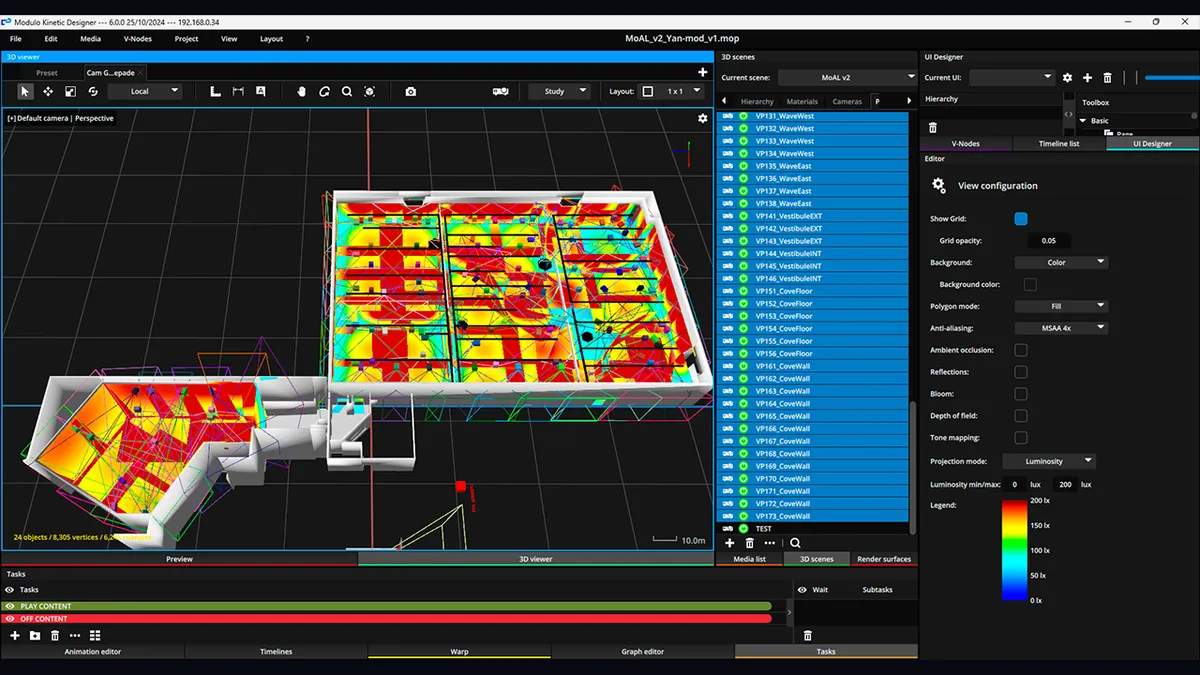
Recommended solution: Modulo Kinetic
Modulo Kinetic offers features that Modulo Player doesn't: 3D project management, 3D autocalibration, native interactivity, unlimited servers. It's the tool for large-scale projects.
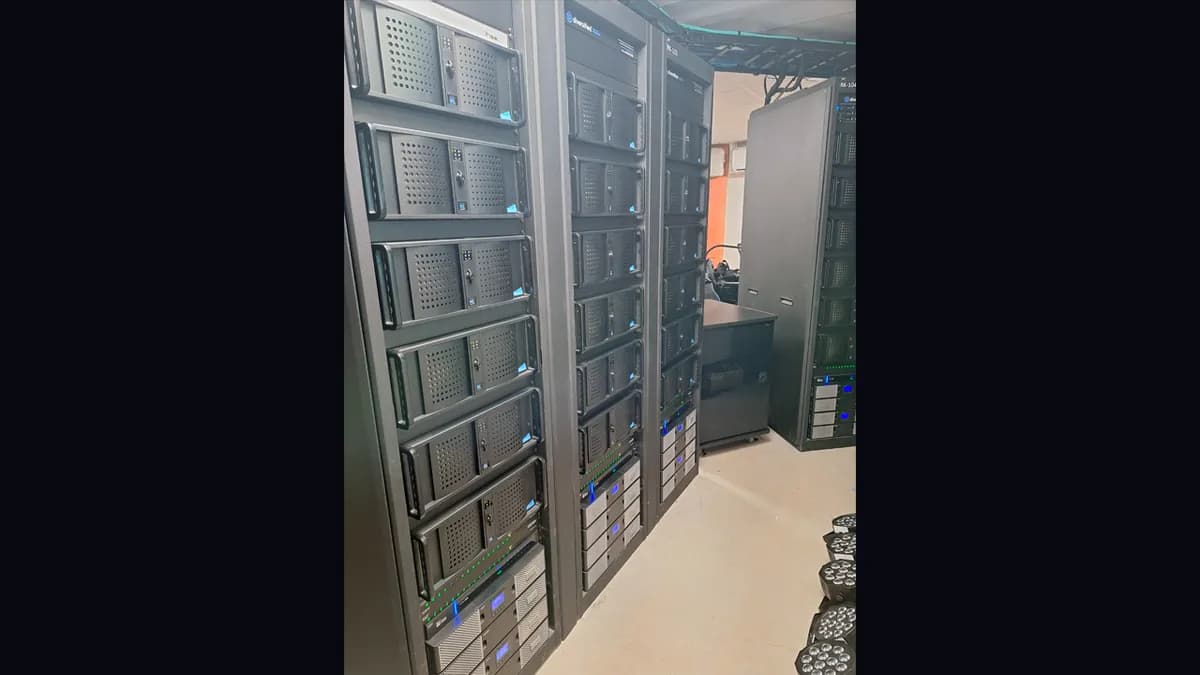
All these features come at a cost. For many projects, they aren't necessary. That's why it's important to properly scope your project upfront, get expert guidance, and precisely define your needs to match your budget.
What about the others?
You may have heard of Watchout or Disguise.
Watchout (Dataton) has been around for over 20 years and has proven itself on many projects. It's a reliable system based on a timeline approach. However, its interface and features have evolved little in recent years compared to more recent alternatives.
Disguise is a powerful tool, particularly focused on real-time rendering with Notch and Unreal Engine integration. It's widely used in broadcast and virtual production. However, its pricing remains high relative to the features offered, which can be hard to justify on many video mapping or immersive installation projects.
The consequences of a bad choice
A poorly chosen media server means:
- Extra cost: you have to buy more hardware mid-project
- Stress: the system doesn't hold up, you're patching things together
- Reputation at stake: the client sees that it doesn't work
These situations are avoidable. Take the time to scope your project upfront, define your real needs, and get expert advice if necessary.
In summary
| Scale | Stakes | Solution |
|---|---|---|
| Small (1-3 projectors) | Low | Resolume, MadMapper, HeavyM, Millumin |
| Professional (up to 10 servers) | Medium to high | Modulo Player |
| Ambitious (10+ servers) | High | Modulo Kinetic |
Conclusion
Choosing a media server isn't just a technical decision. It impacts your budget, your peace of mind, and the success of your project.
Take the time to properly define the scale, the stakes, and the required performance. And if you're in doubt, get expert advice. It's better to invest a little time upfront than to pay the consequences of a bad choice.
Need help choosing the right media server for your project?
Need support for your project?
Let's talk about your project to discuss your projection or mapping project.
Not ready to talk yet? Try our free calculation tools to size your project.

Video mapping consultant and trainer
Fifteen years of monumental and museum-grade installations: Arc de Triomphe (7 editions), Museum of Art and Light Kansas (108 projectors), Atelier des Lumières. Design, multi-projector calibration, audit, Modulo Kinetic training.
Need technical expertise?
Let's discuss your video projection or mapping project. Reply within 48h business hours.
Discuss your projectDid you enjoy this article?
Receive my upcoming tips, field experience and best practices straight to your inbox.
By subscribing, you agree to receive our emails. You can unsubscribe at any time.
1 email per week maximum, unsubscribe in 1 click